Wednesday, August 25, 2010

100 Artists, Albums, and Songs of the New Millenium Better Than Justin Bieber

This is just a list of the music I love and listen to whenever I hear mention or music of that Justin Bieber kid, who I'm sick of.
JB Pictures, Images and Photos
It's been ever so slightly influenced by my friend's "Men Who Are Better Than Edward Cullen" list, which kicked ass (http://dragonwings131.livejournal.com/5010.html#cutid1).

Anyway, all of the music on this list is from the last ten years. Any further back and it'd be too easy and there would be far too much. This makes it a bit tougher and reminds me that there is great music out there today, even if you do have to look outside the mainstream for it.

1. Black Ice by AC/DC
2. Placebo
3. Gorillaz
4. The Darkness
5. The Arctic Monkeys
6. Jack White (White Stripes, Raconteurs, Dead Weather)
7. Flogging Molly
8. Tim Minchin
9. Wolfmother
10. Them Crooked Vultures
11. She & Him
12. Highway Companion by Tom Petty
13. Mojo by Tom Petty & the Heartbreakers
14. The Last DJ by Tom Petty & the Hearbreakers
15. Tegan & Sarah
16. S.J. Tucker
17. Vixy & Tony
18. The Escape Key
19. Repo! The Genetic Opera
20. "Kryptonite" by 3 Doors Down
21. Tenacious D
22. Soundtrack from the movie Across the Universe
23. Raising Sand by Robert Plant & Alison Krauss
24. Avenue Q
25. Stadium Arcadium by the Red Hot Chili Peppers
26. North Mississippi Allstars
27. The Arcade Fire
28. The Greening
29. Neko Case
30. Hang Cool Teddy Bear by Meat Loaf
31. Roll On by The Living End
32. "Wavin' Flag" by K'naan
33. Streetcore by Joe Strummer & the Mescaleros
34. Endless Wire by The Who
35. Nickelback
36. Emotion & Commotion by Jeff Beck
37. IRM by Charlotte Gainsbourg
38. "Calling All Angels" by Train
39. My Old, Familiar Friend by Brendan Benson
40. Blue Gillespie
41. The Answer
42. Grace Potter & the Nocturnals
43. Together by The New Pornographers
44. The Dropkick Murphys
45. Flight of the Conchords
46. Green Day
47. The Roots
48. Film Score to Sherlock Holmes by Hans Zimmer
49. "Hanging by a Moment" by Lifehouse
50. Pitty
51. Frank Turner
52. Dr. Horrible's Sing-a-long Blog
53. Muse
54. American Slang by The Gaslight Anthem
55. Drive-By Truckers
56. "It's My Life" by Bon Jovi
57. "Welcome Home" by Coheed & Cambria
58. Chaos & Creation in the Backyard by Paul McCartney
59. Audioslave
60. Gaelic Storm
61. Haih Or Amortecedor by Os Mutantes
62. "1234" by Feist
63. "Rio" by Hey Marseilles
64. "Beautiful Day" by U2
65. Soundtrack to the movie Once (Glen Hansard & Marketa Irglova)
66. Warpaint by the Black Crowes
67. "Energy" by Apples in Stereo
68. Bang Camero
69. Cage the Elephant
70. Brandi Carlisle
71. "Crazy Bitch" by Buckcherry
72. Chase the Sun
73. Gandalf Murphy & the Slambovian Cirus of Dreams
74. "Still Alive" (from the game Portal) by Jonathan Coulton
75. "Mad World" by Gary Jules
76. Lucero
77. "Teardrop" by Massive Attack
78. The Nels Cline Singers
79. "Lay Down" by Priestess
80. Nightwish
81. Buckethead
82. Within Temptation
83. "Are You Gonna Be My Girl" by JET
84. "Brooklyn is Burning" by Head Automatica
85. "Do You Wanna Date My Avatar" by Felicia Day
86. Prairie Wind by Neil Young
87. "Stricken" by Disturbed
88. "Psycho-Ceilidh Mayhem Set" by Neck
89. The Black Keys
90. Mos Def
91. Radiohead
92. "Yellow" by Coldplay
93. "Short Skirt/Long Jacket" by Cake
94. The Scissor Sisters
95. The Fratellis
96. The Sword
97. The Rising by Bruce Springsteen
98. The Greatest by Cat Power
99. "Ready to Roll" by Jet Black Stare
100. "Break Me" by The Irresponsibles

I'm sure I've missed a few things and left off a few choices here and there, but I'm pretty tired at this point, so cut me some slack if you don't see something you expected.

Top 50 Favorite Albums or, Something Thrown Together While I Write Something Substantive

Down below lies a list of my fifty favorite albums. Outside the top ten, this isn't really in any particular order. Just because Rage Against the Machine is in front of Bringing It All Back Home doesn't mean I like it more. Anyway, it's one album per artist to be fair. Enjoy until I can think of something constructive to write next :-P

1. Revolver--The Beatles
2. Led Zeppelin--Led Zeppelin
3. Quadrophenia--The Who
4. Dark Side of the Moon--Pink Floyd
5. High Voltage--AC/DC
6. Appetite for Destruction--Guns 'n Roses
7. Horses--Patti Smith
8. Beggar's Banquet--The Rolling Stones
9. Permission to Land--The Darkness
10. The Doors--The Doors
11. The Clash--The Clash
12. Born to Run--Bruce Springsteen
13. The Rise & Fall of Ziggy Stardust--David Bowie
14. Cosmo's Factory--Creedence Clearwater Revival
15. War--U2
16. Shake Your Money Maker--The Black Crowes
17. #1 Record/Radio City--Big Star
18. Straight Up--Badfinger
19. Drunken Lullabies--Flogging Molly
20. American Idiot--Green Day
21. Hot Buttered Soul--Isaac Hayes
22. Truth--Jeff Beck
23. Everybody Knows This is Nowhere--Neil Young
24. Meds--Placebo
25. Incredible Jazz Guitar--Wes Montgomery
26. Fresh Cream--Cream
27. G.P./Grievous Angel--Gram Parsons
28. Paranoid--Black Sabbath
29. Rage Against the Machine--RATM
30. Bringing It All Back Home--Bob Dylan
31. Moon Pix--Cat Power
32. Demon Days--Gorillaz
33. Tom Petty & the Heartbreakers--Tom Petty & the Heartbreakers
34. Raw Power--The Stooges
35. Never Mind the Bollocks--The Sex Pistols
36. Band on the Run--Wings
37. (Pronounced 'Leh-nerd Skin-nerd')--Lynyrd Skynyrd
38. The Kinks are the Village Green Preservation Society--The Kinks
39. Elephant--The White Stripes
40. White Light/White Heat--The Velvet Underground
41. Jailbreak--Thin Lizzy
42. Volunteers--Jefferson Airplane
43. Cheap Thrills--Big Brother & the Holding Company
44. Streetcore--Joe Strummer & the Mescaleros
45. Consolers of the Lonely--The Raconteurs
46. Blizzard of Ozz--Ozzy Osbourne
47. Imagine--John Lennon
48. Layla & Other Associated Love Songs--Derek & the Dominos
49. Axis: Bold as Love--The Jimi Hendrix Experience
50. Taste--Taste

Thursday, August 5, 2010

Ramble Tamble

I've been listening to a lot of Creedence Clearwater Revival lately and it's got me thinking about how prolific artists were thirty or forty years ago. Whatever happened to that? In the sixties and seventies, it was perfectly normal for nearly every major band to have a new album out every year, or every other year at most. Today, a band is considered productive if they have an album out every two years, and even that's usually now the exception.

The Beatles were together from 1962 to 1970. In those eight years, they recorded and released thirteen albums that changed pop music. The Rolling Stones released ten equally important albums in the same amount of time between 1964 and 1972 (disregarding the reconfigured US versions for both the Stones and the Beatles). In two years, between 1968 and 1970, the aformentioned CCR released six albums, all classics. The list of bands is endless and continues into the seventies and eighties.

Let's look at some of today's big acts. The White Stripes and Muse have both been around roughly eleven years; the Stripes have recorded six albums while Muse have done five. Radiohead have been around more than fifteen years and have only recorded seven. This year, Gorillaz recorded just their third album in their nine year existence. Green Day, who had five albums in the nineties, only had three this past decade.

And it doesn't just apply to modern artists. Tom Petty, who never really took extended breaks from recording for the first half of his career, has only recorded seven albums in the past twenty years, as opposed to the eight he recorded in only thirteen years between 1976 and 1989. AC/DC's output dropped drastically after 1990's Razor's Edge; they've since recorded just three albums. So what's the deal?

Now to be fair, I know there are outside forces that can keep a band out of the studio. With touring being about the only way they can make money anymore, bands are on the road constantly, and world tours can take well over a year (yet they still can't make it to Memphis?). Band members also often take on side projects or form other bands. Jack White has spent virtually all his time away from Meg with either the Raconteurs, the Dead Weather, or Loretta Lynn. Damon Albarn had his The Good, the Bad, and the Queen and the "Monkey: Journey to the West" production. Josh Homme and Green Day each had two bands on the side in the last ten years. To that end, it can be argued that these side projects and solo outings can fill in those gaps in between the main band's albums, as do live albums, compilations, etc. These can be hit or miss, though, and are especially risky if the finished product is too different from what the band's audience is used to.

The point is that super groups and side projects are nothing new and neither is touring. During the height of Beatlemania, the Beatles recorded six albums between 1962 and 1966, and that's in the midst of several world tours and the makings of two films. Led Zeppelin played two-hour shows nearly every night in the early days and managed to crank out four great albums in three years. Cream, the original super group, was just as productive. And just to beat the dead CCR horse again: six albums in two years. That's amid world tours as well.

But I know, there are other factors involved. There's inner turmoil, general fatigue and family time (especially for the older acts), and sometimes things that just come out of the blue that can't be helped. Pre-American Idiot, Green Day had already started work on their next album not long after Warning in 2000 when the tapes were stolen, delaying their work but ultimately leading to one of their best records. Wolfmother took three years to release a second record due to inner turmoil that led to the replacement of the rhythm section. There are probably other reasons for it that I don't fully understand. I'm sure the record industry would prefer it's artists to be making money touring rather than losing money making albums at a time when CD sales are sliding and pirates are bootlegging everything.

Of course, it can be argued (rightfully so) that these long breaks between recording is a good thing that breeds longevity for a band. Green Day and Pearl Jam have both been around over twenty years now, as have the Black Crowes, though they recently announced an indefinite hiatus. Anybody who's been in a band, a stage production, hell, just in a car with a group of people for an extended period will tell you that too much time spent with the same people can get tense. As great as they were, the Beatles only lasted eight years and they had begun disintegrating in only five. Pink Floyd spent every year of the seventies either in the studio or on tour together and by the end of the decade they despised each other. Of course, this theory doesn't seem to work for the now-dead Oasis and the Gallagher brothers, nor does it explain how the hell the Rolling Stones are still together (or alive).

Could these down times be improving the quality of each new album? Possibly; it could be that more time in between albums gives writers more time to flesh out their work properly so that the music doesn't sound rushed. Still, plenty of great albums have been created during the most tumultuous band schedules. I do realize, though, that Neil Young released quite a few albums in the eighties, nearly all of which sucked (though he was going through some rough times), as did the Stones.

So is this a problem? Not really; with everything else confronting music today--piracy, sliding sales, a rough economy, autotune, Ke$ha--this hardly qualifies as a problem. I just think it would be refreshing to find a band with a good sound that can produce full albums (not EPs, not remixes, not compilations) every year or two. Of course, I get the feeling this is all just wishful thinking and it's not likely a band like that will come along any time soon. None worth hearing, anyway. Prove me wrong, music world!

Thursday, March 18, 2010

A Word On Alex Chilton

I don't have a whole lot to say about Alex Chilton; I've never been the world's biggest Box Tops or Big Star fan, though I like both bands. "The Letter" was always a favorite cover of ours when Crimson Timebomb was together, and I have a rudimentary knowledge of Big Star's most well-known songs like "The Ballad of El Goodo," "Thirteen," and "September Gurls." It's impossible for any Memphis resident who loves classic rock to not know of Chilton or either of his bands, and anyone who loves the opening to "That 70's Show" has him to thank for the opening song, "In the Street." Still, other than that, I don't know much about him or his music. There are loads of people who can talk about him more eloquently and in far greater detail than I ever could.

I tend to compare him to two other Memphis music legends--Elvis Presley and Isaac Hayes. All three were huge influences on popular music, although Chilton was probably the least known of the three, settling into a legacy as a cult figure more than rock god. His influence is all over power pop and rock music since the seventies, much of which has been well documented by now. Even though I've listened to more Elvis than Big Star, and even though I've met and spoken to Isaac, I still feel closer to Alex Chilton.

I think it's because he was so young in his prime with the Box Tops and Big Star. He was a young rock star, about my age, from Memphis, and that's all he ever was. Elvis came from out of town, hit it big, and became a worldwide cultural figure who transcended the limits of just a rock star. Hayes was the same way, to a lesser extent, fulfilling multiple music roles in his prime at Stax and later becoming just as well-known as Chef on "South Park" to the younger generation.
Chilton wrote and played rock 'n roll music, that's all. He never achieved the fame of many of his peers, but he had a dedicated group of followers. More so than Isaac or Elvis, he let his feelings out in his music, from the innocent love songs ("Thirteen," "I'm In Love With A Girl") to the energetic rockers ("Don't Lie to Me," "You Get What You Deserve") to the angst and depression (pretty much all of the Third/Sister Lovers album). While Elvis didn't write most of his hits, and Hayes was a better musical arranger and composer, Chilton was the best lyricist of the three, and certainly among the greats of classic rock.

In a way, Chilton reminds me of Gram Parsons. Both were exceptional songwriters, neither were ever commercially successful, but they were both very influential to the development of rock music, as well as my own musical education. When Chilton died this week, amid all the Big Star I was listening to, I had random urges to listen to Parson's albums, G.P. and Grievous Angel, as well as the Flying Burrito Brothers. Incidentally, in a 1991 interview on NPR's "Fresh Air," Chilton stated that he was influenced by the Flying Burrito Brothers around the time he formed Big Star, so perhaps that has something to do with it.

I guess what makes this sad to me is that it's another chapter of Memphis' music history coming to an end, just as Isaac's death did a couple years ago. While Ardent Studios is still in business, and Stax has seen a resurgence in interest, the old identity of Memphis as an important music city continues to fade. It's another reminder of how much I wish I had grown up in the Sixties and Seventies to experience the musical culture of this city (although I'm sure my parents would argue otherwise).

In any case, it's a shame to have lost Alex Chilton so suddenly. He continued playing until the end, and would have played tonight with Big Star at the South by Southwest Festival, which will now be used as a star-studded tribute show in his honor. With any luck, though, his legacy will continue and the current generation will pick up his records and their guitars. Whether or not any of them make it big, whether or not they put Memphis back on the musical map, they'll be playing good rock music, and I think that's what Alex would have wanted.

Tuesday, March 9, 2010

Gorillaz-Plastic Beach

null Pictures, Images and Photos

Ah, Gorillaz, how refreshing it is to hear you again. I still remember when "Clint Eastwood" first came out back in 2001. At a time when the Beatles ruled my CD player, that was one of the few modern songs I was addicted to. The music video was like nothing I'd seen before and it had a great hook to it, even if I wasn't into hip-hop at all. I didn't really pay attention to the rest of the band's music till a few years ago, after Demon Days came out in 2005, but they're easily one of my favorite bands of the decade, one of the few modern acts that I follow.
The eponymous debut was an experimental and excessive collection of creator Damon Albarn's influences, from Britpop to electronic, hip-hop to dub to punk. It was certainly diverse, but it was also messy and inconsistent on the whole. For every radio-friendly "Clint Eastwood" or "19-2000," there was an unnecessary or unconventional track like "Punk" or "Latina Simone." It was a good start, but it sounded like a band still trying to find its identity.
Demon Days was a more condensed and accessible, albeit darker, album. It had more memorable, catchy songs like "Feel Good Inc.," "Dare," and "Dirty Harry" while mixing in bleak, thoughtful songs like "Kids With Guns," "El MaƱana," and "Last Living Souls." The record hit number one in the UK and made Gorillaz international stars.
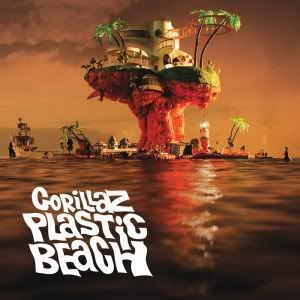
Plastic Beach takes the ambition of Demon Days and pushes it into an overall brighter direction. Two loose themes make up the content of the songs. The first--and most obvious theme, as evident from the title and album cover--is the sunny aquatic beach setting. The other, as suggested by the other half of the title "Plastic" is the modern material world.
As usual, Albarn is joined by a hodgepodge of guests, and this time it's the most star-studded gathering yet. The album opens with Snoop Dogg himself welcoming us to the Plastic Beach. Rapper Mos Def takes a solo number on the club hip-hop/marching band-tinged "Sweepstakes" after sharing lines with Albarn and Rock & Roll Hall of Famer Bobby Womack on "Stylo." Fellow alumni of the Hall join Womack, including Velvet Underground leader Lou Reed (sounding much less preserved than Womack) and Clash members Mick Jones and Paul Simonon, who played bass with Albarn in the supergroup, The Good, the Bad, and the Queen. Other guests include Swedish electronic band Little Dragon, Gruff Rhys, The Fall frontman Mark E. Smith, and rappers Kano, Bashy, and De La Soul.
The result is the first Gorillaz album to have songs with guest vocals outnumbering sole-Albarn songs. In some cases, Albarn doesn't even sing, and these songs can be hit-or-miss and make the record feel less like a Gorillaz album, and while they do tend to have that effect, there are songs like "Sweepstakes" or Womack's soulful "Cloud of Unknowing" that make you forget your quibble. Other times you have a song like "Glitter Freeze," an unimpressive instrumental in which Mark E. Smith says so few lines that you wonder why he even bothered appearing, or why they even bothered recording the track at all.
Still, most of the guest tracks have shared vocals with Albarn and they work the best, even the stranger songs like the oddball "Superfast Jellyfish." The best example would be "Stylo," in which the lyrics get tossed back and forth from Mos Def to Albarn to Womack. The three distinct voices and styles make it one of the most dynamic and interesting Gorillaz songs yet.

The thing I appreciate most about Albarn's songwriting is that he almost never duplicates his own work. In the cases of some bands like, just as examples, AC/DC and the White Stripes (BOTH OF WHOM I LOVE), there are the occasional throwaway songs that, when you listen to them, tend to sound a little too familiar. You get the vague feeling that you've heard that guitar riff before, or that particular chord progression or melody, etc.
Throughout the course of Gorillaz' three albums, however, I haven't gotten that feeling. Sure, they all still have a distinct sound that is synonymous with Gorillaz, but every song gives me something different to hear. Even throwaway tracks like "Glitter Freeze" or Demon Days' "White Light" have something about them that's distinct and different from any other Gorillaz song. It keeps the music from getting repetitive while retaining the band's sound, and so the albums continue to please.
At this point, it's hard to say if many of the tracks will become classics on the level of "Clint Eastwood" or "Feel Good Inc." There are catchy songs on here, to be sure. "Stylo," with it's memorable electronic rhythm, is a surefire fan favorite, and songs like "Rhinestone Eyes" and "Up on Melancholy Hill" have their hooks. It just feels like they're missing something. I guess it's too early to tell what's going to be remembered in ten years, but this album has all the makings of a classic Gorillaz album, so with any luck, it will live up to the fandom's expectations.

One thing I can't help noticing, though, is the diminished presence of the virtual band itself. Plastic Beach marks the first Gorillaz album to not feature any band members on the album cover. Three members--2D, Murdoc, and Noodle--appear on the back, but Russell is absent. This is also seen in the music video for "Stylo," in which the same three are in a getaway car together, but once again, no Russell. Does all this mean it's the beginning of the end of the cartoon band? Granted, Jamie Hewlitt's odd quartet creation has always been a bit of a novelty gag, something to separate it from the rest of the mainstream, but they've always had a prominent presence amid the previous albums' releases. Now, it seems they've taken a bit of a back seat to their creator, who's only keeping them around now to justify the name and to keep the fans happy.

Of course, this is a purely aesthetic aspect of the band and it doesn't have any impact on the music itself. It seems in this case that the image of the band has been traded in by Albarn for the concepts featured in the music. As previously mentioned, the main themes of the album are the beach and the modern material world of consumerism and commercialism. The beach theme is a bit more loose and comes up most prominently at the beginning of the album.

Much of the album, though, is dedicated to the concept of our modern world. "The revolution will be televised," Snoop Dogg declares in the opening, a stark contrast to the Gil Scott-Heron song it parodies in reference to our world of 24-hour news channels and social networking sites. "Superfast Jellyfish" begins as a spoof of a breakfast commercial, complete with a sample of an old food ad. Other songs like "Melancholy Hill" and "Broken," among others, have the voice of someone who feels lost amid the culture of constant advertising and consumerism and trapped by the marvels of modern technology. All of this skepticism and longing comes wrapped in the bright-colored packaging that is the music of Plastic Beach.

Where does Gorillaz go from here? After the hype and touring has died down, will there be another album? Will Albarn and Hewlitt have any interest to keep these characters alive, or will they move on to other projects? Unfortunately, it's hard to tell if there's much life left in the virtual band after all this is over, but that's all dependent on their creators. Both have proven that their open to other projects outside the band, both collaborative and solo. However, if the end is near, Plastic Beach is a good way to go out on top. It's classic Gorillaz and Damon Albarn, and it's been a fun ride.