Ah, Gorillaz, how refreshing it is to hear you again. I still remember when "Clint Eastwood" first came out back in 2001. At a time when the Beatles ruled my CD player, that was one of the few modern songs I was addicted to. The music video was like nothing I'd seen before and it had a great hook to it, even if I wasn't into hip-hop at all. I didn't really pay attention to the rest of the band's music till a few years ago, after Demon Days came out in 2005, but they're easily one of my favorite bands of the decade, one of the few modern acts that I follow.
The eponymous debut was an experimental and excessive collection of creator Damon Albarn's influences, from Britpop to electronic, hip-hop to dub to punk. It was certainly diverse, but it was also messy and inconsistent on the whole. For every radio-friendly "Clint Eastwood" or "19-2000," there was an unnecessary or unconventional track like "Punk" or "Latina Simone." It was a good start, but it sounded like a band still trying to find its identity.
Demon Days was a more condensed and accessible, albeit darker, album. It had more memorable, catchy songs like "Feel Good Inc.," "Dare," and "Dirty Harry" while mixing in bleak, thoughtful songs like "Kids With Guns," "El Mañana," and "Last Living Souls." The record hit number one in the UK and made Gorillaz international stars.
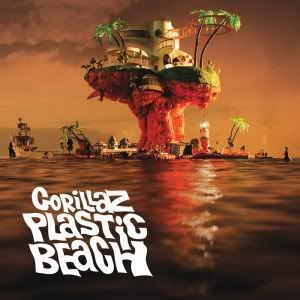
Plastic Beach takes the ambition of Demon Days and pushes it into an overall brighter direction. Two loose themes make up the content of the songs. The first--and most obvious theme, as evident from the title and album cover--is the sunny aquatic beach setting. The other, as suggested by the other half of the title "Plastic" is the modern material world.
As usual, Albarn is joined by a hodgepodge of guests, and this time it's the most star-studded gathering yet. The album opens with Snoop Dogg himself welcoming us to the Plastic Beach. Rapper Mos Def takes a solo number on the club hip-hop/marching band-tinged "Sweepstakes" after sharing lines with Albarn and Rock & Roll Hall of Famer Bobby Womack on "Stylo." Fellow alumni of the Hall join Womack, including Velvet Underground leader Lou Reed (sounding much less preserved than Womack) and Clash members Mick Jones and Paul Simonon, who played bass with Albarn in the supergroup, The Good, the Bad, and the Queen. Other guests include Swedish electronic band Little Dragon, Gruff Rhys, The Fall frontman Mark E. Smith, and rappers Kano, Bashy, and De La Soul.
The result is the first Gorillaz album to have songs with guest vocals outnumbering sole-Albarn songs. In some cases, Albarn doesn't even sing, and these songs can be hit-or-miss and make the record feel less like a Gorillaz album, and while they do tend to have that effect, there are songs like "Sweepstakes" or Womack's soulful "Cloud of Unknowing" that make you forget your quibble. Other times you have a song like "Glitter Freeze," an unimpressive instrumental in which Mark E. Smith says so few lines that you wonder why he even bothered appearing, or why they even bothered recording the track at all.
Still, most of the guest tracks have shared vocals with Albarn and they work the best, even the stranger songs like the oddball "Superfast Jellyfish." The best example would be "Stylo," in which the lyrics get tossed back and forth from Mos Def to Albarn to Womack. The three distinct voices and styles make it one of the most dynamic and interesting Gorillaz songs yet.
The thing I appreciate most about Albarn's songwriting is that he almost never duplicates his own work. In the cases of some bands like, just as examples, AC/DC and the White Stripes (BOTH OF WHOM I LOVE), there are the occasional throwaway songs that, when you listen to them, tend to sound a little too familiar. You get the vague feeling that you've heard that guitar riff before, or that particular chord progression or melody, etc.
Throughout the course of Gorillaz' three albums, however, I haven't gotten that feeling. Sure, they all still have a distinct sound that is synonymous with Gorillaz, but every song gives me something different to hear. Even throwaway tracks like "Glitter Freeze" or Demon Days' "White Light" have something about them that's distinct and different from any other Gorillaz song. It keeps the music from getting repetitive while retaining the band's sound, and so the albums continue to please.
At this point, it's hard to say if many of the tracks will become classics on the level of "Clint Eastwood" or "Feel Good Inc." There are catchy songs on here, to be sure. "Stylo," with it's memorable electronic rhythm, is a surefire fan favorite, and songs like "Rhinestone Eyes" and "Up on Melancholy Hill" have their hooks. It just feels like they're missing something. I guess it's too early to tell what's going to be remembered in ten years, but this album has all the makings of a classic Gorillaz album, so with any luck, it will live up to the fandom's expectations.
One thing I can't help noticing, though, is the diminished presence of the virtual band itself. Plastic Beach marks the first Gorillaz album to not feature any band members on the album cover. Three members--2D, Murdoc, and Noodle--appear on the back, but Russell is absent. This is also seen in the music video for "Stylo," in which the same three are in a getaway car together, but once again, no Russell. Does all this mean it's the beginning of the end of the cartoon band? Granted, Jamie Hewlitt's odd quartet creation has always been a bit of a novelty gag, something to separate it from the rest of the mainstream, but they've always had a prominent presence amid the previous albums' releases. Now, it seems they've taken a bit of a back seat to their creator, who's only keeping them around now to justify the name and to keep the fans happy.
Of course, this is a purely aesthetic aspect of the band and it doesn't have any impact on the music itself. It seems in this case that the image of the band has been traded in by Albarn for the concepts featured in the music. As previously mentioned, the main themes of the album are the beach and the modern material world of consumerism and commercialism. The beach theme is a bit more loose and comes up most prominently at the beginning of the album.
Much of the album, though, is dedicated to the concept of our modern world. "The revolution will be televised," Snoop Dogg declares in the opening, a stark contrast to the Gil Scott-Heron song it parodies in reference to our world of 24-hour news channels and social networking sites. "Superfast Jellyfish" begins as a spoof of a breakfast commercial, complete with a sample of an old food ad. Other songs like "Melancholy Hill" and "Broken," among others, have the voice of someone who feels lost amid the culture of constant advertising and consumerism and trapped by the marvels of modern technology. All of this skepticism and longing comes wrapped in the bright-colored packaging that is the music of Plastic Beach.
Where does Gorillaz go from here? After the hype and touring has died down, will there be another album? Will Albarn and Hewlitt have any interest to keep these characters alive, or will they move on to other projects? Unfortunately, it's hard to tell if there's much life left in the virtual band after all this is over, but that's all dependent on their creators. Both have proven that their open to other projects outside the band, both collaborative and solo. However, if the end is near, Plastic Beach is a good way to go out on top. It's classic Gorillaz and Damon Albarn, and it's been a fun ride.


No comments:
Post a Comment